
English| EUR
Suggested for you
More currencies
Choose a language
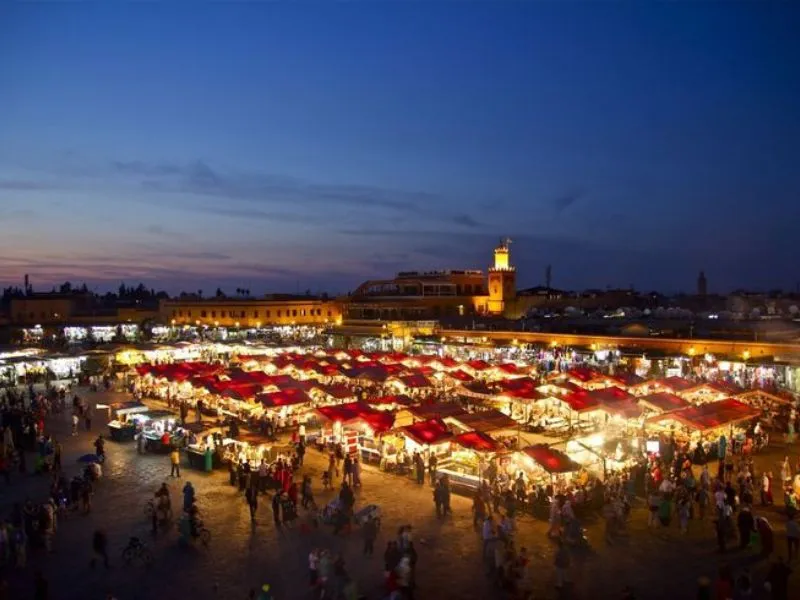
Jemaa el-Fnaa transforms into Marrakesh's largest open-air dining room after sunset, with dozens of numbered stalls serving identical-looking dishes at wildly different prices. Knowing what vendors charge locals versus tourists determines whether you spend 80 or 250 dirhams for the same meal. This guide maps the actual cost of every staple from the grills, tagine pots, and juice carts.
Quick answer
Marrakech street food prices at Jemaa el-Fnaa range from 5 MAD for fresh orange juice to 60 MAD for a full grilled meat platter. Most single dishes—tagine, brochettes, harira soup—cost between 15 and 30 MAD when you pay the local rate. The square operates with free entry around the clock; you pay only for what you order at individual stalls, and prices rise sharply after 20:00 when tour groups arrive.
Every evening stall in Jemaa el-Fnaa displays a laminated menu board, but the prices printed there apply only if you ask for them first. Walk the grid before you sit—stall 14 charges 25 dirhams for six lamb brochettes while stall 31 asks 50 for the same skewers off the same supplier's truck. The core Marrakech street food prices hold steady across the square: a bowl of harira with dates and chebakia runs 10 to 15 MAD, a tagine of kefta or chicken costs 20 to 30 MAD, and a mixed grill with bread and salad sits between 40 and 60 MAD depending on the cut and the stall number. Snails served in broth—boiled with thyme, anise, and liquorice root—cost 10 MAD per bowl at the dedicated snail carts on the square's northern edge. Fresh-squeezed orange juice from the daytime carts costs 4 to 6 MAD per glass; after dark the same pour climbs to 10 MAD when poured by a stall runner. The pricing structure splits along arrival time. Between 18:00 and 20:00, vendors compete for local diners and expatriates who know the rhythm; menu boards reflect neighborhood rates and stall managers negotiate before you sit. After 21:00, when the square fills with group tours on tight schedules, the same dishes carry a 30 to 50 percent margin and negotiation ends. A 30-dirham tagine becomes 45, a 50-dirham mixed grill becomes 75, and vendors stop volunteering the price until the plate arrives. Bring small bills. Stalls that quote in dirhams will accept euros at an aggressively rounded rate—10 euros for a 60-dirham plate—and claim to have no change. The orange juice vendors and snail carts keep coins; the numbered dinner stalls do not. Payment happens after you eat, once the manager has sized up whether you asked the price before ordering. The square's rhythm is transactional, not theatrical: vendors call out, gesture toward their grills, and move on when you decline. The food itself—smoky, salted, priced for volume—tastes the same whether you paid the local fare or twice that amount, but knowing the benchmark turns the haggle from anxiety into arithmetic.
“A 30-dirham tagine becomes 45 after 21:00, when group tours fill the square and negotiation ends.”
There is no entrance fee to access the public street food areas in Marrakech. Visitors pay directly for individual food items at each stall according to their personal consumption.
Verdict: Total expenditure depends entirely on the number and type of food items selected rather than fixed entrance costs.
The best arrival window is 18:00–22:00, when peak activity ensures maximum food stall variety and a vibrant atmosphere. Visiting during this time allows you to sample a wide array of options while vendors are fully operational.
Pleasant, 20°C–28°C
Ideal weather for walking between stalls without excessive heat.
Mild, 22°C–30°C
Warm evenings provide a comfortable environment for outdoor dining.
Hot, 30°C–40°C
Expect intense heat during the day, making evening visits essential for comfort.
Cool, 8°C–20°C
Evenings can be chilly, so bring layers while exploring the food stalls.
Verdict: For the best balance of variety and weather, plan your visit between 18:00–22:00 during the months of April or October.
The street food areas in Jemaa el-Fnaa remain accessible throughout the week to accommodate visitors seeking local cuisine. Stalls maintain a consistent daily schedule to ensure availability for those exploring the market.
The primary hub for street food in Marrakech is Jemaa el-Fnaa, located at Jemaa el-Fnaa, Marrakech 40000, Morocco. Most visitors access the square by entering the medina through one of the primary gates and proceeding toward the central plaza.
Arrival at Jemaa el-Fnaa drop-off point
Line L1 or L19 to Jemaa el-Fnaa stop
Follow signs to Medina/Jemaa el-Fnaa
Taxis cannot enter the pedestrian-only zones of the medina, so request drop-off at the nearest accessible point to the square. Navigating toward the Koutoubia Mosque provides a clear landmark for locating the entrance to the food stalls.
Visitors often misjudge the dynamics of Jemaa el-Fnaa's food stalls, leading to overpayment or disappointing timing. Clarifying prices before ordering and aligning your visit with peak hours prevents most issues.
Ordering without asking the price first
Always confirm the cost per item before the vendor begins preparation. Vendors may quote tourist rates if you skip this step, and disputes become awkward once food is served.
Arriving outside the 18:00–22:00 window
Plan your visit between 18:00 and 22:00 when stall variety peaks and the atmosphere is most vibrant. Earlier or later arrivals mean fewer vendors and limited menu choices.
Accepting the first price quoted
Politely negotiate or compare prices across neighboring stalls before committing. Initial quotes can be inflated, and a brief walk often reveals better rates for identical dishes.
Ignoring cash-only payment requirements
Bring sufficient Moroccan dirhams in small denominations, as card payments are not accepted at street stalls. ATMs near Jemaa el-Fnaa can have long queues during peak hours.
Skipping smaller stalls for crowded ones
Crowds don't always signal better value or quality. Less busy vendors often offer competitive prices and faster service while maintaining the same food standards.
Everything you need to know about marrakech street food prices
Determining marrakech street food prices depends on your appetite, as you pay per individual item rather than a fixed entry cost. Most snacks like grilled meats, tagine samples, or fresh juices are very affordable for travelers. Budgeting a modest daily amount allows you to sample a wide variety of local flavors.
There is 0 MAD entrance fee to access the public street food areas in Jemaa el-Fnaa. You only pay directly to the vendors for the specific culinary items you choose to purchase. This makes the area accessible for casual browsing and dining.
The best arrival window is 18:00–22:00 when the area reaches peak activity. During these hours, you will find the maximum variety of food stalls and a vibrant atmosphere. Visiting outside this window may result in fewer open vendors.
When considering marrakech street food prices, remember that you pay only for what you consume. Official guided Marrakech street food tours may carry their own booking costs, but walking the public market independently requires no pre-paid access. Be mindful of setting prices with vendors before ordering to ensure clarity.
The market is a sensory, family-friendly environment where you can easily manage marrakech street food prices by choosing smaller portions. It is advisable to supervise children closely due to the high volume of foot traffic. Many vendors offer mild options suitable for younger palates.
The market operates daily from 08:00–23:59, ensuring consistent access throughout the week. While the area is open all day, the evening remains the most active period for street food enthusiasts. Always plan your visit within these stated hours to ensure all stalls are prepared for service.
Is It Safe to Eat Street Food in Marrakech?
Read more Tickets & toursBook a Local Guide for Your Food Tour
Read more Tickets & toursMarrakech Night Street Food Tours
Read more Tickets & toursVegetarian Street Food Tours in Marrakech
Read more Tickets & toursPrivate Marrakech Street Food Tours
Read more