
3 hr
Marrakech Morning & Evening Street Food Walk
Discover hidden culinary gems with a local guide through authentic neighborhoods far from tourist crowds
Reserve
Hand-picked by our editors — only the best 5 food walks from 23 reviewed.
Verified partners for every tour, free cancellation where available, and instant confirmation on every booking.
3 hr
Discover hidden culinary gems with a local guide through authentic neighborhoods far from tourist crowds
Reserve
4 hr
Discover authentic Moroccan cuisine in local neighborhoods far from the tourist trail
Reserve
3 hr
Wander the night markets and hidden food stalls of the Medina with a local guide and taste the city.
ReservePrices from verified partners. Availability updates in real time at checkout. Free cancellation policies apply where shown.
The landmarks, rooms, and views travelers on this tour remember — all visible on a single visit.
This UNESCO-listed square transforms every evening into a bustling open-air market with hundreds of stalls. It serves as the historic center of the city and is the starting point for most food tours.
Famous for traditional slow-roasted lamb, this area offers a concentrated glimpse into centuries-old Moroccan cooking techniques. Visitors can watch local chefs prepare meat in underground pits.
Standing as the iconic landmark of the city, its silhouette provides a stunning backdrop to the evening market activity. It is the largest mosque in Marrakesh.
A vibrant alleyway filled with authentic spice vendors, fresh produce, and local snack shops. It is one of the most atmospheric paths for a guided culinary walk.
The main thoroughfare of the Medina where visitors can find everything from textiles to pottery. It provides a sensory-rich walk before reaching the food stalls.
Guided tours offer curated safety and deep insights, while the self-guided approach provides total freedom; most visitors find the vegetarian street food tour marrakech far more efficient for navigating complex alleyways.
| Feature | Top pick Vegetarian Street Food Tour | Self-Guided Exploration |
|---|---|---|
Navigational Ease |
Expert local guide | Self-directed mapping |
Safety/Hygiene Assurance |
Vetted vendors only | Requires personal judgment |
Menu Variety/Knowledge |
Curated plant-based focus | Limited to visible options |
Cost |
Market-rate service fees | 0 MAD entry cost |
Depth of Cultural Context |
Direct historical narratives | Atmospheric observation only |
| See tickets → |
Verdict: This vegetarian street food tour marrakech tour is ideal for those prioritizing comfort and education, whereas the self-guided option suits independent travelers seeking flexible vegetarian street food tour marrakech tickets and pace.
Choose your ticket, select your date, and reserve in under two minutes. Secure checkout handled by our verified partner.
Instant confirmation by email, with a mobile voucher you can save offline. No printing, no queuing at a collection desk.
Arrive at the entrance, show your voucher on your phone, and walk in. Most tickets include priority or skip-the-line access.
Practical details for your visit straight from our verified partners — hours, access, rules, and how to get there.
Modest clothing is recommended while walking through the Medina to respect local customs. Comfortable, supportive walking shoes are essential for navigating uneven cobblestones.
Keep all bags and personal items securely fastened and worn in front of your body in crowded areas. Avoid carrying unnecessary valuables during your walking experience.
Always ask for permission before photographing local vendors or street performers in Jemaa el-Fnaa. Be aware that some performers may request a fee for photos.
The Medina’s narrow, uneven alleys are not fully accessible for wheelchairs or those with limited mobility. Please verify specific route adjustments with your operator.
The vegetarian street food tour marrakech is generally family-friendly, though the sensory intensity of the night market may be overwhelming for young children. Contact your provider regarding specific age policies.
Most tours include bottled water and multiple tastings; vegetarian options are widely available upon request when booking your vegetarian street food tour marrakech tour.
Best time to go, insider tips, nearby landmarks, and the cancellation fine print — flip through to skim what matters to you.
Flexible, no hidden fees.
Full refunds are typically available for cancellations made at least 24 hours in advance. Please refer to your specific booking confirmation for the exact terms applicable to your vegetarian street food tour marrakech tickets.
Marrakesh's vegetarian street food tradition predates the term itself. For centuries, Berber farmers and Arab traders brought lentil stews, chickpea flatbreads, and olive-stuffed pastries into the Medina's market squares, where religious fasting days created reliable demand for meatless fare. By the nineteenth century, Jemaa el-Fnaa had become the empire's largest open-air kitchen, its western edge lined with vendors selling msemen drizzled with honey, bowls of bissara thick enough to hold a spoon upright, and snail broth simmered in clay pots over charcoal braziers. Today, the square remains the culinary heart of Marrakesh. Every evening, more than three hundred stalls assemble between the Koutoubia minaret and the souk gates, their braziers casting orange light across the cobblestones. Vegetarian options dominate the southern and western rows, where second- and third-generation vendors prepare dishes that have changed little in method or ingredient since their grandparents first claimed the same patch of ground. A vegetarian street food tour marrakech pulls from this living archive, threading together centuries-old recipes that survive not as museum pieces but as working food. The architecture of the Medina itself shapes the eating. Narrow derbs funnel foot traffic past spice merchants and olive pressers, their storefronts open to the street. The scent of cumin and coriander hangs in the air long after sunset. Vendors along Rue Riad Zitoun el-Kedim sell zaalouk, a smoky eggplant and tomato relish eaten cold with khobz, and taktouka, a roasted pepper salad sharpened with preserved lemon. Further north, near the tanneries, women prepare harira without lamb, the tomato-and-chickpea base thickened with lentils and finished with a squeeze of lime. Plant-based Moroccan street food tours have grown in response to demand from European travelers and younger Moroccan urbanites, but the dishes themselves are neither new nor adapted. They are the weekday food of rural households, the Ramadan tables of observant families, the vendor meals eaten by porters and craftsmen who could not afford meat daily. What has changed is visibility. Where once a visitor might struggle to identify which stalls served vegetarian dishes, guided walks now map the quarter's hidden specialists, the vendors whose reputations rest on a single perfected recipe. The result is not fusion or innovation but recovery, a deliberate return to the plant-forward core of Moroccan home cooking.
"The dishes are neither new nor adapted — they are the weekday food of rural households, the Ramadan tables of observant families."
A step-by-step walkthrough of the visit — what you'll see, how long each stage takes, and the details that matter.
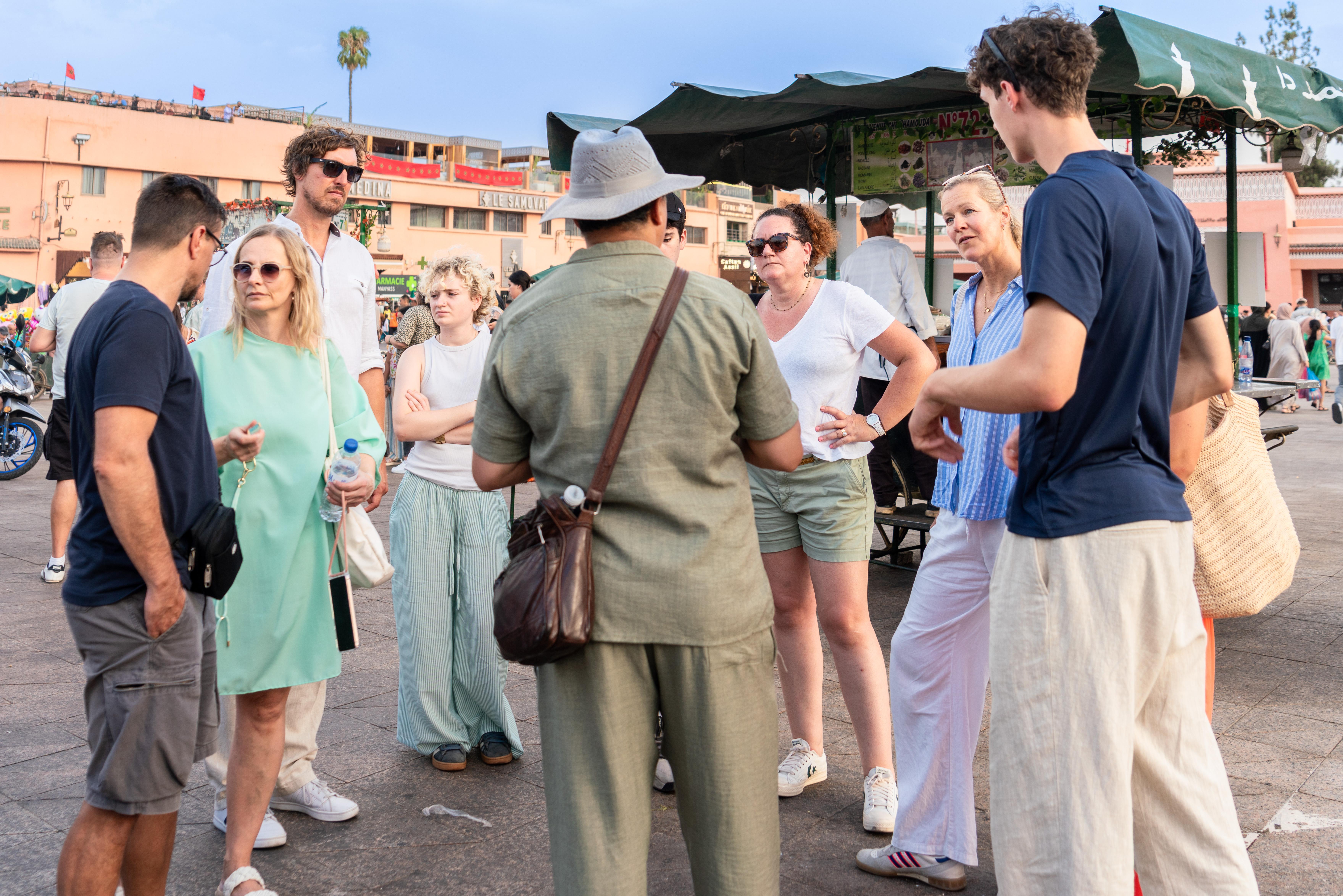
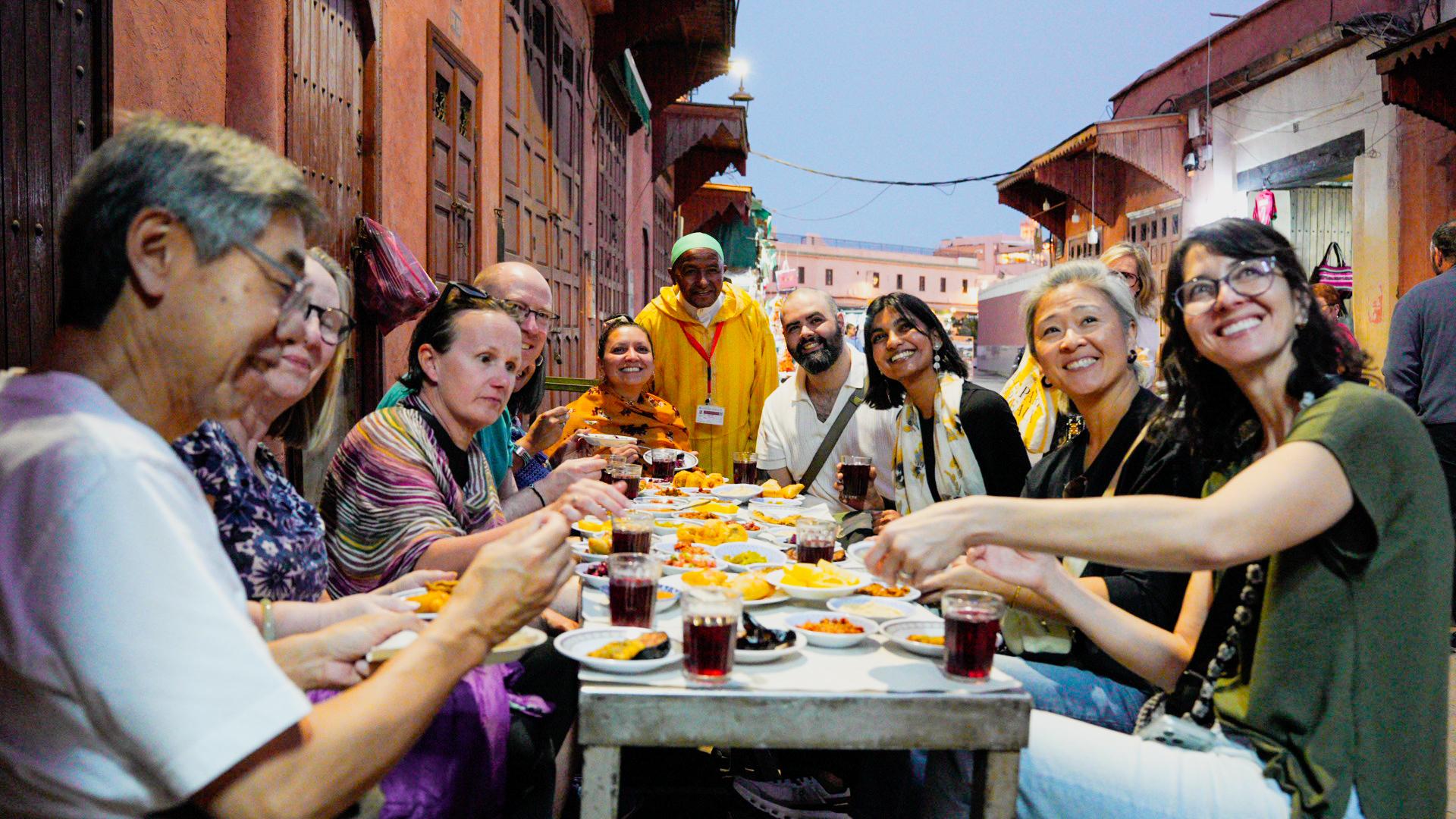
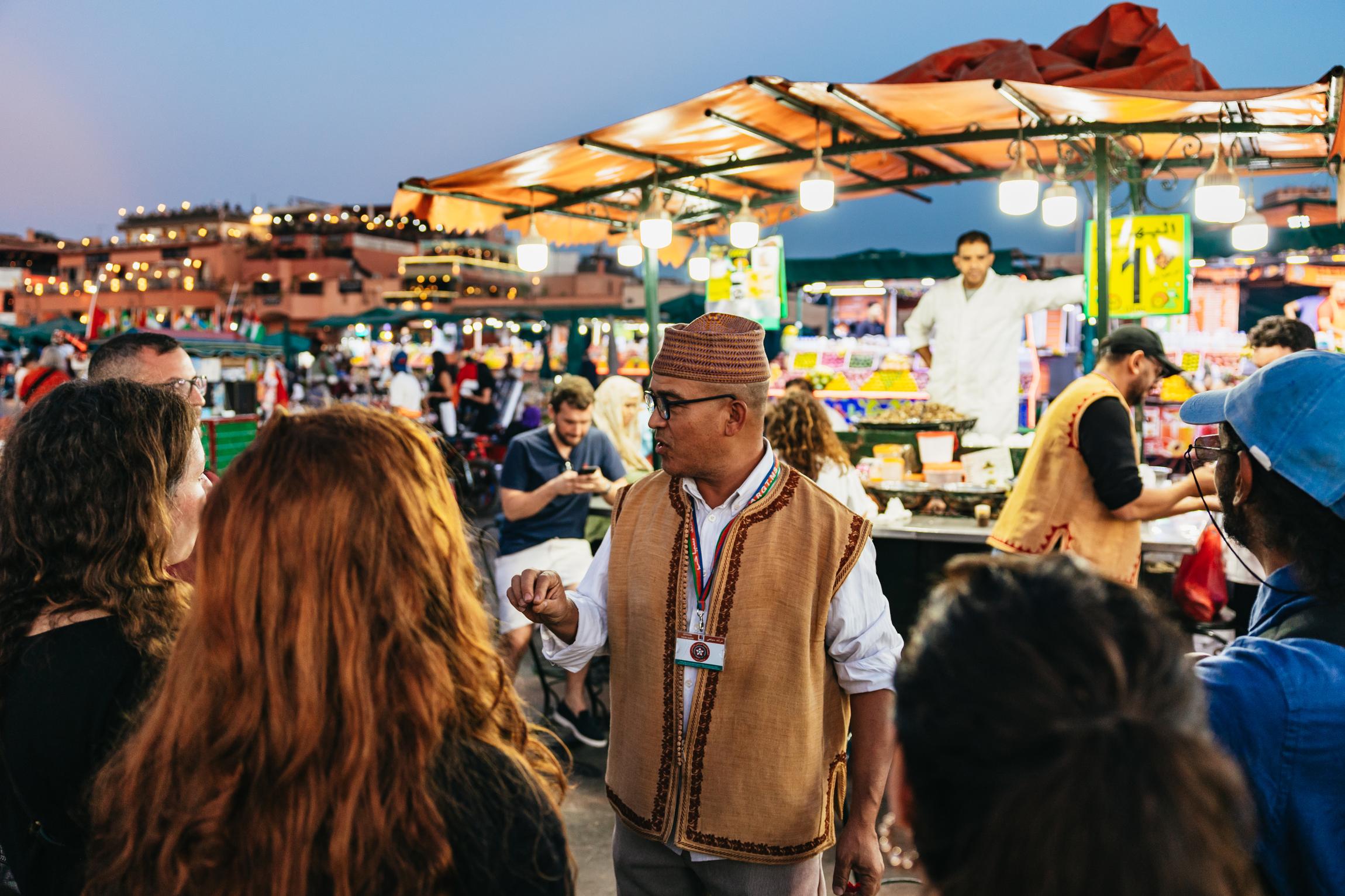
You meet your guide at dusk near the Koutoubia Mosque, where the call to prayer echoes across the square. The first stop is a cart selling steamed fava beans dressed with olive oil, cumin, and paprika, served in a cone of waxed paper. You eat standing, the way locals do. The route moves east into the souks. At a stall no wider than a doorway, the vendor fries msemen on a flat griddle, folding the dough into crisp squares. You dip each piece into a dish of honey and ground almonds. Three streets further, you pause at a spice merchant who grinds his own ras el hanout, explaining the difference between the thirteen-spice and twenty-one-spice blends. You taste both on a square of warm bread. Back at Jemaa el-Fnaa, the evening market is in full swing. Your guide navigates to a row of vegetarian-only stalls near the snake charmers. You sit on a low bench and eat from shared plates: zaalouk, taktouka, a bowl of harira still steaming, and a plate of fried eggplant dusted with sugar and cinnamon. The guide orders mint tea without asking, poured from a height into small glasses. The final stop is a bakery open to the street, where rounds of khobz rotate inside a wood-fired oven. You leave with one wrapped in paper, still hot enough to warm your hands.
Yes, you can secure your spot for a vegetarian street food tour marrakech by booking through authorized travel platforms.
The activity itself is private, but the Jemaa el-Fnaa area is open 00:00–23:59 daily.
Yes, many operators consider the experience family-friendly for children, though group settings may vary.
Most guides can accommodate dietary needs; inform them when booking your vegetarian street food tour marrakech.
We recommend arriving at Jemaa el-Fnaa between 18:00–22:00 to experience full market activity.
Yes, most tours include bottled water and traditional mint tea.
The standard meeting point is the main post office in Jemaa el-Fnaa, located in the heart of the Medina.
Photography is generally welcome, but always ask vendors before capturing their stalls.
Policies vary by provider, but free cancellation is often offered up to 24 hours before the service.
Absolutely, you can easily combine your visit with the Koutoubia Mosque or nearby souks before your tour starts.